What’s the Difference Between a Dodge Hellcat and a Scat Pack?
Short answer: the Hellcat has a supercharger and the Scat Pack does not. That single difference accounts for roughly 220 horsepower, about $25,000 when these cars were new, and a running-cost gap that is wider than most buyers expect.
Updated: August 13, 2026 // Questions
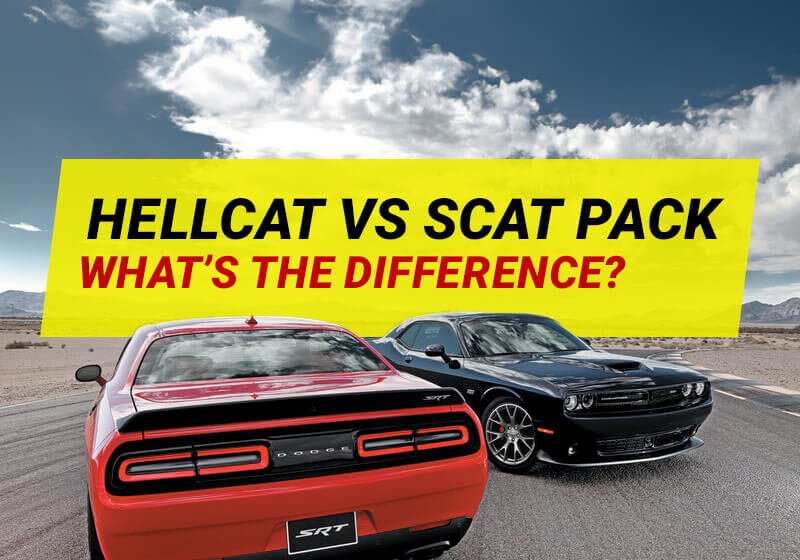
Both nameplates are now used cars, at least in their V8 form. Dodge built the last Challenger in December 2023, and the trims that replaced them are a very different proposition. More on that below.
The engines are the whole story
Scat Pack: 6.4-liter Hemi V8, 485 horsepower, 475 lb-ft. Naturally aspirated, no forced induction, 392 cubic inches. It is the same basic engine Dodge put in heavy-duty Ram trucks and the Jeep Wrangler 392, which tells you something about how it was built. It makes its power high in the rev range and it sounds like a proper V8 doing it.
Hellcat: 6.2-liter Hemi V8, 707 horsepower, 650 lb-ft. Supercharged, and the first factory-supercharged Hemi. Dodge’s SRT division built it for 2015 and the number was so far beyond anything else in the segment that it reset expectations for the entire class.
The Hellcat engine then spawned a family: the Redeye at 797 horsepower, the Super Stock at 807, the Demon at 808 on pump gas, and finally the Demon 170 at 1,025 horsepower running E85. Our Demon versus Hellcat breakdown covers how those variants differ from each other.
What that feels like from the driver’s seat
The Scat Pack is the more conventional car and, for a lot of people, the better one. Power builds predictably, the throttle is easy to modulate, and you can use most of what it has on a public road without immediately becoming a problem.
The Hellcat is not really a faster version of the same experience. The supercharger means the torque arrives everywhere, all at once, which makes the car feel less like it is accelerating and more like it is being pulled. On anything other than dry pavement it will spin the rear tires at speeds where you would not expect that to be possible.
Dodge understood this. Hellcats shipped with two key fobs: a black one that limited the engine to around 500 horsepower and a red one that unlocked everything. If you are shopping used, confirm both keys are present, because our guide to replacing a Hellcat red key covers what that costs, and it is not trivial.
What they cost new
For reference, since these numbers are now historical rather than shoppable. In 2023, the final model year, the Challenger SRT Hellcat listed around $72,000 and the Charger version around $79,000. The Challenger R/T Scat Pack started around $47,000 and the Charger Scat Pack around $49,000.
Roughly $25,000 separated them. Whether that gap was worth 220 horsepower was the central question of every Dodge showroom conversation for eight years.
The gap nobody mentions: what they cost to own
This is where the honest comparison lives, and where the price difference stops being a one-time decision.
Fuel. Both want 91 octane minimum and the Hellcat really wants 93. Neither is efficient, but a Hellcat driven the way a Hellcat invites you to drive it will return single-digit mpg. Budget accordingly.
Tires. The Scat Pack goes through rear tires. The Hellcat destroys them. Widebody cars run 305-section rears, and a set is a serious expense that arrives more often than you would like.
Insurance. The gap here is significant and catches younger buyers badly. A 707-horsepower coupe is priced very differently from a 485-horsepower one, and in some markets the Hellcat is difficult to insure at all under a certain age. Our overview of how car insurance works is worth reading before you commit to either.
Heat. Supercharged cars manage heat as a constant background problem. Repeated hard runs cause the Hellcat to pull power to protect itself, which means the gap between the two cars on a hot day at a drag strip is narrower than the spec sheet suggests.
Maintenance. The supercharger, its intercooler system, and the associated plumbing are all additional things to service and eventually replace. The 6.4 has none of them.
Which should you actually buy?
Buy the Scat Pack if this is a car you plan to drive regularly, if you are insuring it yourself and under forty, or if you want the muscle car experience without a monthly cost that feels like a second car payment. It is not slow. It is a mid-four-second 0-60 car that will embarrass most things on the road.
Buy the Hellcat if the number matters to you, and be honest about whether it does. That is a legitimate reason. Owning the most powerful production muscle car of its era is worth something, and now that production has ended it is worth more than it was. Just go in knowing the running costs are the real price.
Buy neither if you actually want to go around corners. Both are heavy and both were built for straight lines. Our used Challenger pros and cons guide is blunt about the compromises, and the Mustang versus Challenger comparison is the right place to start if handling is high on your list.
Do these trims still exist?
Partly, and not in the form you would recognize.
The Challenger and the outgoing Charger are gone. Dodge’s new Charger carries both names forward, but the Scat Pack badge now sits on the electric Charger Daytona, alongside an R/T trim, while the internal-combustion option is the Charger Sixpack with a 3.0-liter twin-turbo inline-six rather than a V8.
There is currently no supercharged Hemi in a new Dodge. Whether the Hellcat name returns has been an open question since the new Charger was announced, so check recent news rather than relying on any page’s archive. Our full Challenger evolution history covers how the V8 era ended.
Side by side
| R/T Scat Pack | SRT Hellcat | |
|---|---|---|
| Engine | 6.4L Hemi V8 | 6.2L supercharged Hemi V8 |
| Horsepower | 485 | 707 |
| Torque | 475 lb-ft | 650 lb-ft |
| Induction | Naturally aspirated | Supercharged |
| 2023 Challenger MSRP | About $47,000 | About $72,000 |
| Minimum fuel | 91 octane | 91 octane, 93 preferred |
| Two-key system | No | Yes, black and red |
| Best for | Daily driving and value | Outright power and collectibility |
Common questions
Is a Scat Pack faster than a Hellcat?
No. The Hellcat has roughly 220 more horsepower. On a poor surface a skilled driver can narrow the gap, because the Hellcat struggles for traction, but in any fair comparison the Hellcat wins.
What does Scat Pack mean?
It revives a Dodge marketing name from 1968 used for a group of performance models. The bee logo comes from that era.
Can you supercharge a Scat Pack?
Yes, and aftermarket kits are common. It will not turn it into a Hellcat, because the Hellcat has a different block, forged internals, and a stronger drivetrain built for the load.
Is the Hellcat worth the extra money?
As a driving purchase, the Scat Pack is the better value by a wide margin. As a collectible, the Hellcat has held value better and production has now ended, which changes the math.
Which is cheaper to insure?
The Scat Pack, by a substantial margin. Get quotes on both before you decide, because the difference can exceed the payment difference.