
Mazda Miata: Is It Always The Answer?
Ask any forum what car to buy and someone will reply "Miata is always the answer" before reading the question. They are usually right, and the interesting part is the times they are not. Here is every generation, what they cost now that clean NAs have stopped being cheap, and the honest list of situations where the answer is something else.
Updated: August 19, 2026 // Gearhead Car Reviews
Home // Gearhead Car Reviews //
The MX-5 works because Mazda got one decision right in 1989 and then refused to reverse it for thirty-five years. Keep it light, keep it balanced, and do not chase horsepower. Every generation has been criticised for being slow, and every generation has outlasted the faster cars that mocked it.
It is also the best-selling two-seat sports car in history, passing one million units in 2016, which for a car nobody at Mazda was certain would sell is a remarkable outcome.
Where it came from
The MX-5 emerged from an internal Mazda programme called Offline Go-Go, abbreviated OGG. The “go-go” part is five-five in Japanese, and it referred to the threshold each experimental project had to clear: a 55 percent estimated chance of reaching production. It was a structured way of letting engineers chase ideas without the company committing to every one of them.
Mazda’s mainstream lineup at the time was the Familia, Capella, Luce, RX-7 and Bongo. Planning work from late 1983 identified room for a small kei car, a van, and a lightweight sports car positioned below the RX-7. Those became the Carol, the MPV, and the MX-5.
The brief was to recreate the British roadster experience without the British ownership experience. Small, rear-drive, open-topped, and mechanically simple, but built to Japanese reliability standards so it would start on a wet morning. It debuted at the Chicago Auto Show in February 1989 into a market obsessed with horsepower, and sold on being the exact opposite.
Every generation
NA: 1990 to 1997
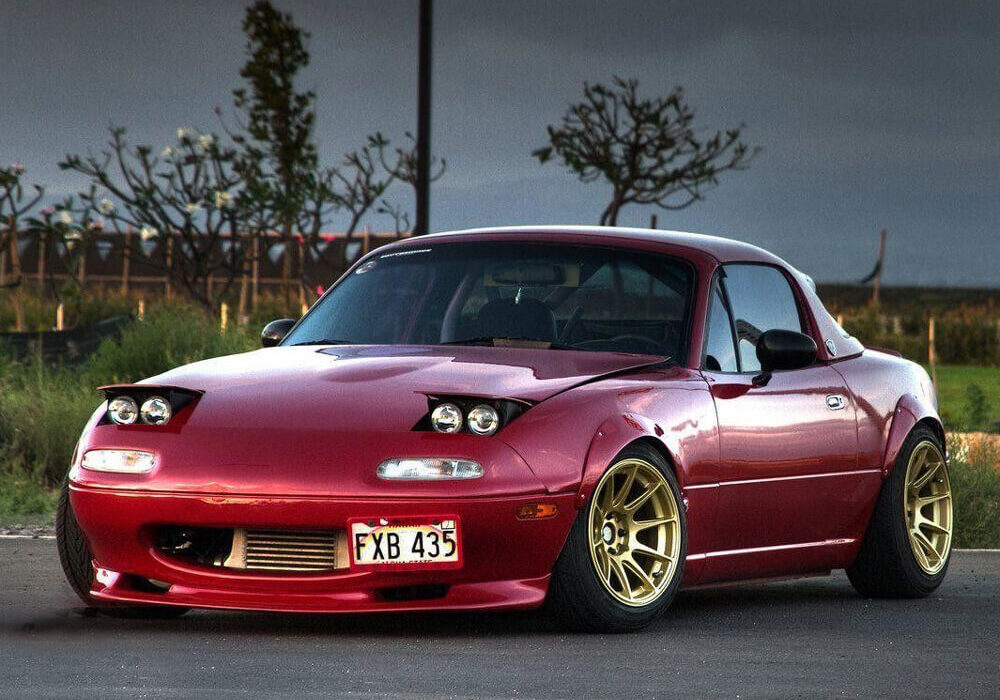
Pop-up headlights, around 2,200 pounds, and a 1.6-litre engine making roughly 115 horsepower. It took about nine seconds to reach 60 mph, which was unremarkable then and is slow now, and it did not matter in the slightest.
A 1.8-litre arrived for 1994 with 128 horsepower, rising to 133 for 1996. The NA is the purist’s choice and the one that has appreciated most. It is also the one most likely to have rust, so inspect the rockers, rear arches and frame rails carefully.
NB: 1999 to 2005
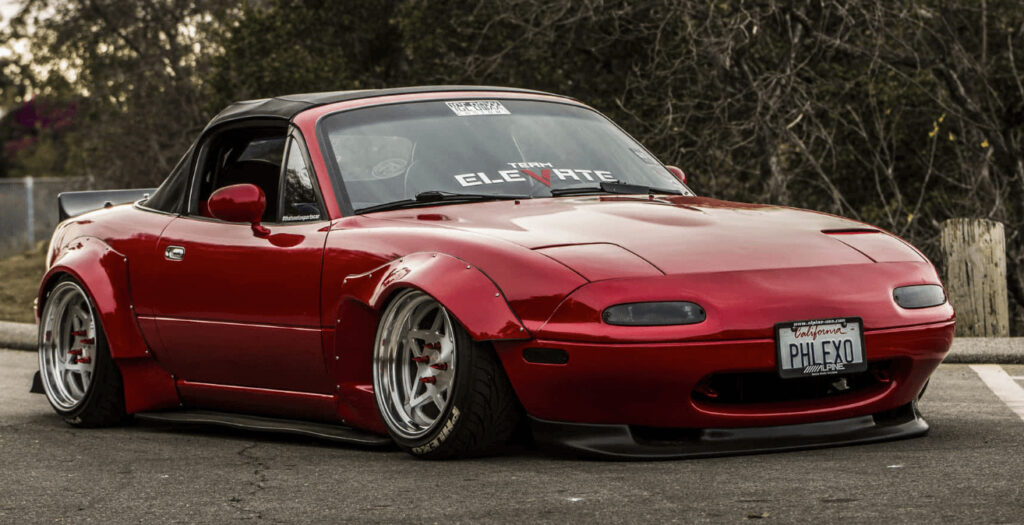
The pop-ups went, largely because of pedestrian impact regulations, and enthusiasts have never entirely forgiven Mazda for it. Underneath, this is the same car improved: stiffer shell, better brakes, and a 1.8-litre making 140 horsepower, raised to 142 in 2001 when variable valve timing arrived.
The NB is the value pick of the range. It drives almost identically to the NA, it is newer, and it costs less because the headlights fold into the bodywork rather than out of it.
It also produced the only factory forced-induction Miata: the Mazdaspeed MX-5 of 2004 and 2005, turbocharged to 178 horsepower. Roughly 5,400 were built and they command a premium now.
NC: 2006 to 2015
The largest and heaviest Miata, at around 2,500 pounds, and the one enthusiasts argue about. Wider track, fender bulges, and a 2.0-litre engine rated at 170 horsepower at launch, revised to 167 for the manual and 158 for the automatic from 2009. That inconsistency in published figures trips people up constantly, and both numbers are correct for different years.
The NC also introduced the power retractable hardtop, which added about 80 pounds and folded in twelve seconds without eating trunk space. It is the most usable Miata for daily driving and consequently the cheapest to buy.
ND: 2016 to present
Mazda did the unthinkable and made the car smaller and lighter again, cutting over 200 pounds from the NC while sharpening the styling considerably.
Early ND cars made 155 horsepower, and this is the detail most write-ups miss: for 2019 Mazda substantially revised the engine, raising output to 181 horsepower and lifting the redline to 7,500 rpm. That is a meaningful difference, and it makes 2019 the year to target if you are shopping used. The RF variant added a folding hardtop with flying buttresses.
Specifications by generation
| Generation | Model years | Engine | Horsepower | Torque |
|---|---|---|---|---|
| NA | 1990-1993 | 1.6L | 115 hp | 100 lb-ft |
| NA | 1994-1997 | 1.8L | 128 to 133 hp | 110 lb-ft |
| NB | 1999-2000 | 1.8L | 140 hp | 119 lb-ft |
| NB | 2001-2005 | 1.8L VVT | 142 hp | 125 lb-ft |
| NB | 2004-2005 Mazdaspeed | 1.8L turbo | 178 hp | 166 lb-ft |
| NC | 2006-2008 | 2.0L | 170 hp | 140 lb-ft |
| NC | 2009-2015 | 2.0L | 167 hp manual, 158 automatic | 140 lb-ft |
| ND | 2016-2018 | 2.0L | 155 hp | 148 lb-ft |
| ND | 2019 onward | 2.0L | 181 hp | 151 lb-ft |
Why the answer is usually yes
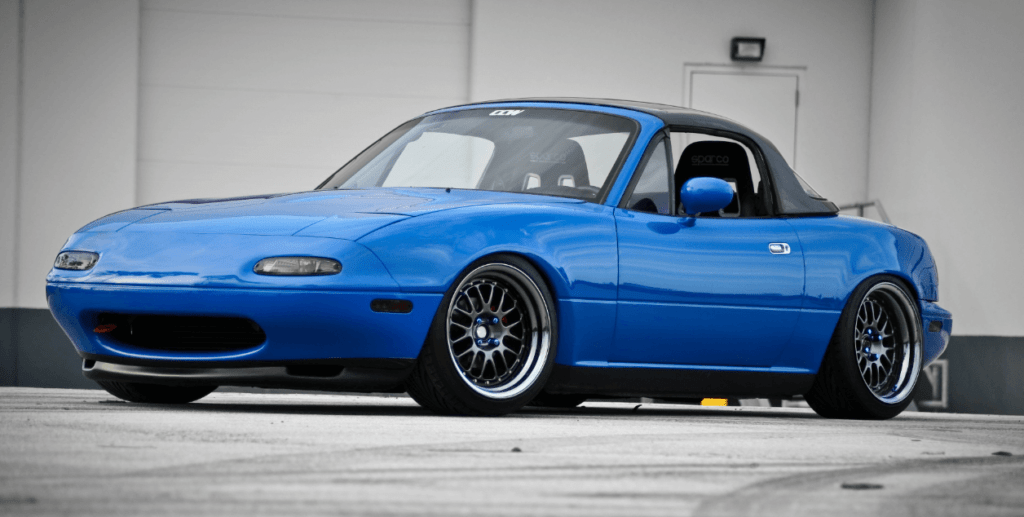
The balance. Close to 50/50 weight distribution, a low centre of gravity, and not enough power to overwhelm the chassis. The result is a car that tells you exactly what the tyres are doing at speeds that will not lose you a licence. Very few cars at any price communicate this clearly.
It is reliable. Genuinely, boringly reliable, which is not something the British roadsters it imitated could claim. Parts are cheap, the aftermarket is enormous, and the known faults are well documented and mostly cheap to fix.
It is easy to work on. Simple mechanicals, huge online knowledge base, and a community that has documented essentially every job. This is a good first car to learn spannering on, and our guide to performance upgrades you can do yourself applies well here.
Insurance is reasonable. No turbo in standard form, modest power, and a good safety record mean quotes come back far lower than for a comparably fun car. That matters enormously for younger drivers, and our overview of how insurance is calculated explains why.
The community. Comparable to the Jeep Wrangler for depth and enthusiasm. Whatever has gone wrong with your car, someone has already photographed the fix.
When the answer is no
The question in the headline deserves an actual answer, so here it is.
If you need to carry anything. Two seats, a small boot, and no back seat at all. A big supermarket run is a genuine logistical problem.
If you are tall. NA and NB cars in particular run out of legroom and headroom quickly. Anyone over about six foot two should sit in one, with the roof up, before committing to anything.
If you want straight-line speed. A standard Miata will lose to a family crossover from a set of lights. That is the trade, and the car makes no apology for it.
If it has to be your only car in a cold climate. Rear-wheel drive, light back end, soft top on most examples. Manageable with winter tyres and completely miserable without them.
If security matters where you park. A fabric roof can be cut. Never leave anything visible inside.
If you want a sleeper. A two-seat convertible sports car is the opposite of anonymous. If that is the goal, our list of the best modern sleeper cars is a better starting point.
What they cost now
The old advice that Miatas are cheap needs updating. Clean, unmodified NA cars have appreciated significantly and good examples are no longer bargain territory, with the best commanding real collector money.
The value is in the NB and the NC. Both drive beautifully, both are plentiful, and neither has been swept up by the collector market yet. An NC in particular is the most car for the least money in this whole range.
Whichever you choose, buy on condition and records rather than mileage, and get underneath it before you agree a price. Our guide to the best places to buy a used car covers where to look. If you are considering a Japanese-market Eunos Roadster instead, our guide to importing a car into the United States explains the 25-year rule that makes those possible.
Modifications worth doing, in order
Most Miata mod lists start with engine swaps, which is backwards. The car responds best to the cheap stuff, and the sensible order looks like this.
1. Tyres. The single highest-return change on any Miata. A light car with good rubber transforms, and the standard sizes are inexpensive. Fifteen or sixteen inch wheels are the sweet spot, and going larger adds unsprung weight for no real gain.
2. Suspension and sway bars. A quality set of springs or coilovers plus a rear sway bar sharpens turn-in and reduces body roll noticeably. Cheap coilovers are a false economy here.
3. Brakes. Better pads and fluid before bigger rotors or calipers. Most Miatas do not need more braking hardware, they need hardware that resists fade. If you do upsize, check clearance against your wheel size and offset first.
4. Seats and a harness bar. Rarely mentioned and hugely effective. Being held in place lets you feel what the car is doing, which is the entire point of the thing.
5. Lightweight flywheel. Lets the engine rev more freely and makes the gearbox feel quicker. It does not add power, and it does add some drivetrain noise.
6. Exhaust and intake. Modest gains, mostly noise. Do these because you want to hear the engine, not because you expect meaningful horsepower.
7. Forced induction. Adding a turbocharger or supercharger, since no standard Miata comes with either apart from the Mazdaspeed. A well-specified kit transforms the car, and a badly specified one destroys the engine. This is not a first project, and it needs a competent installer and supporting fuel and cooling work.
8. V8 swap. The most extreme option, popularised by kits that fit a small-block GM V8 into the engine bay. Enormously fast, enormously expensive, and it changes the car’s character completely. Worth being honest that the result is a different vehicle rather than a better Miata.
If you are weighing up a modified example on the used market, our JDM project car pros and cons guide is worth reading first, and the Miata’s popularity on track and in drifting circles means plenty of hard-used cars are circulating.
So, is it always the answer?
Not always. But the reason the joke persists is that for the specific question of how to have the most fun per dollar on a public road, in a car you can afford to insure and repair, nothing has beaten it in thirty-five years of trying.
Buy one for what it is rather than what you wish it were, and it will be the answer more often than not.
Common questions
Which Miata generation is best?
The NB offers the best balance of purity and price. The NC is the cheapest and most usable daily. The ND from 2019 onward is the best car outright, thanks to the 181-horsepower engine.
What year Miata is best for modifying?
A 1994 to 1997 NA with the 1.8-litre engine, which is stronger than the 1.6 and better supported by the aftermarket. NBs are almost as well served and cost less.
What is the most common Miata problem?
A ticking noise from the hydraulic lifters, most often reported on 1990 to 1997 cars and usually linked to irregular oil changes. Rust is the more serious concern on any early example.
Why do Miatas handle so well?
Low weight, a low centre of gravity, and near 50/50 weight distribution. Mazda deliberately chose balance over power, and everything follows from that.
Is a Miata a good first car?
For many drivers, yes. It is reliable, cheap to insure, easy to maintain, and not powerful enough to get an inexperienced driver into trouble quickly. The limitations are practical rather than mechanical: two seats, small boot, and rear-wheel drive in winter.
How hard is it to turbocharge a Miata?
Not difficult with a proven kit and proper research, but it is a real project rather than a bolt-on. Supporting fuel, cooling and tuning work all matter, and skipping any of it is how engines die.








Sources:
- Inside Mazda | Mazda USA. (2022, April 8). Inside Mazda. https://insidemazda.mazdausa.com/
- Car News and Information | Motor1.com. (2023, May 22). Motor1.com. https://www.motor1.com/