Ford Bronco vs Bronco Sport: What’s Actually Different
These two share a name, a grille, and almost nothing else. The Bronco is body-on-frame with a two-speed transfer case and doors you can take off. The Bronco Sport is a unibody crossover built on the same platform as an Escape. Everything below follows from that one difference, including which one you should actually buy.
Updated: August 19, 2026 // Versus
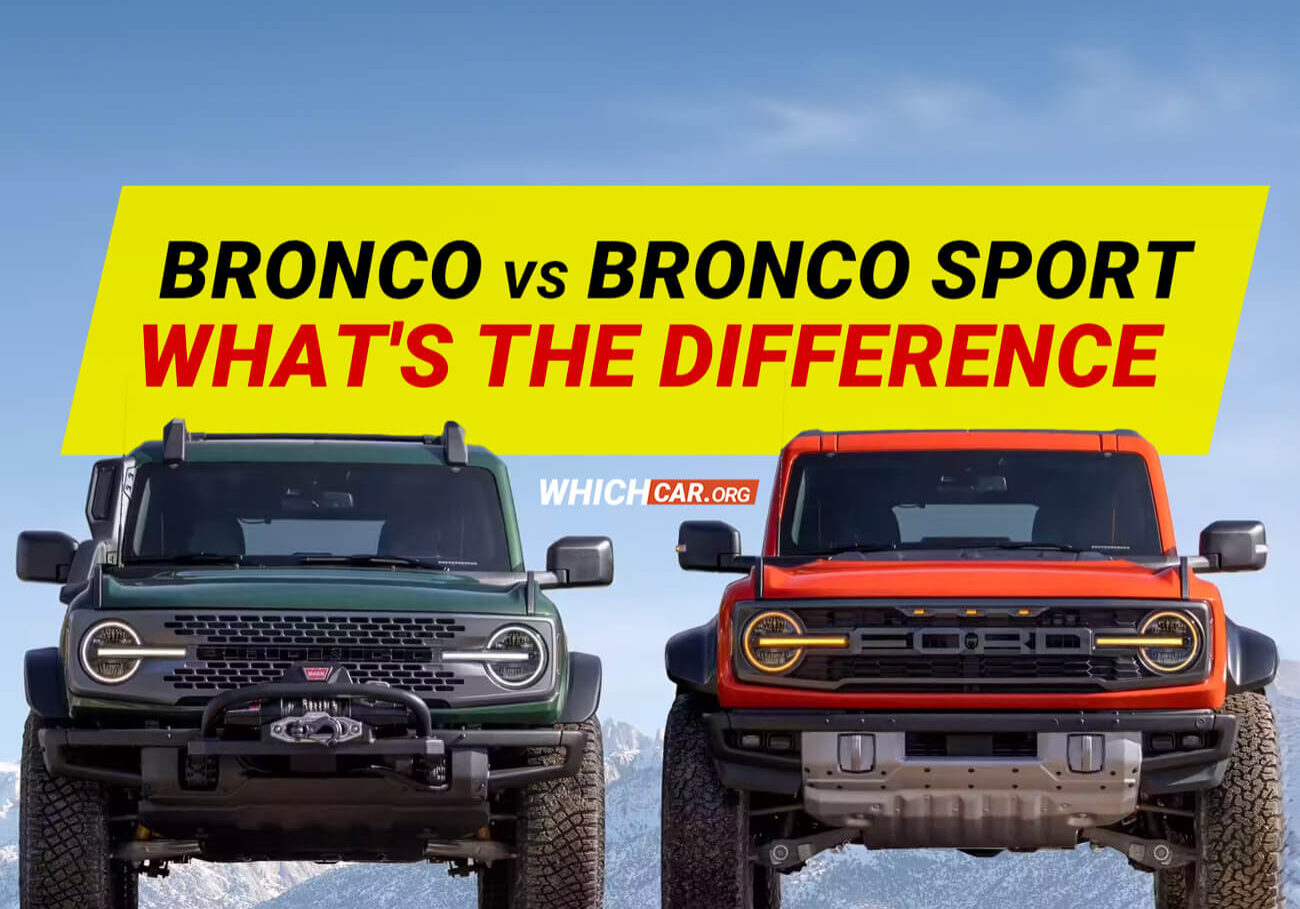
Ford put the same name and the same face on two completely unrelated vehicles, which was a marketing decision rather than an engineering one. The confusion it created is real, and it costs people money when they buy the wrong one.
So start with the thing that matters and work outward.
The difference that explains everything else
The Bronco is body-on-frame. A separate ladder frame with a body bolted on top, a longitudinal engine, rear-wheel drive as the baseline, and a two-speed transfer case with a genuine low range. This is truck architecture, the same basic approach as a Wrangler or a pickup.
The Bronco Sport is a unibody crossover. One welded structure, a transverse engine, front-wheel drive as the baseline with all-wheel drive available. It shares its underpinnings with the Ford Escape.
Every other difference on this page is downstream of that. Towing, cargo, off-road capability, ride quality, fuel economy, and price all follow from which construction method Ford chose.
One nuance worth having: the Bronco uses independent front suspension rather than a solid front axle, which is where it differs from the Wrangler. That costs it a little articulation at the extremes and gains it a lot of on-road composure.
Removable doors and roof
Only the Bronco. The doors come off, the roof panels come off, and on the four-door the whole hardtop can be removed. Ford designed the mirrors onto the body rather than the doors specifically so the car stays legal with the doors in your garage.
The Bronco Sport has fixed doors and a fixed roof. If open-air driving is on your list, the comparison ends here.
Powertrains
Bronco Sport: a 1.5-liter turbocharged three-cylinder making 181 horsepower and 190 lb-ft, or a 2.0-liter turbo four making 250 horsepower and 277 lb-ft. The 2.0 does 0 to 60 in around 7.2 seconds.
Bronco: a 2.3-liter turbo four making 300 horsepower and 325 lb-ft, or a 2.7-liter twin-turbo V6 making 330 horsepower and 415 lb-ft, which manages 0 to 60 in roughly 6.7 seconds despite the weight.
The Bronco also offers a seven-speed manual with a crawler gear on the four-cylinder, which nothing else in the segment does. Above all of it sits the Bronco Raptor, with a considerably more powerful version of the V6 and desert-running suspension.
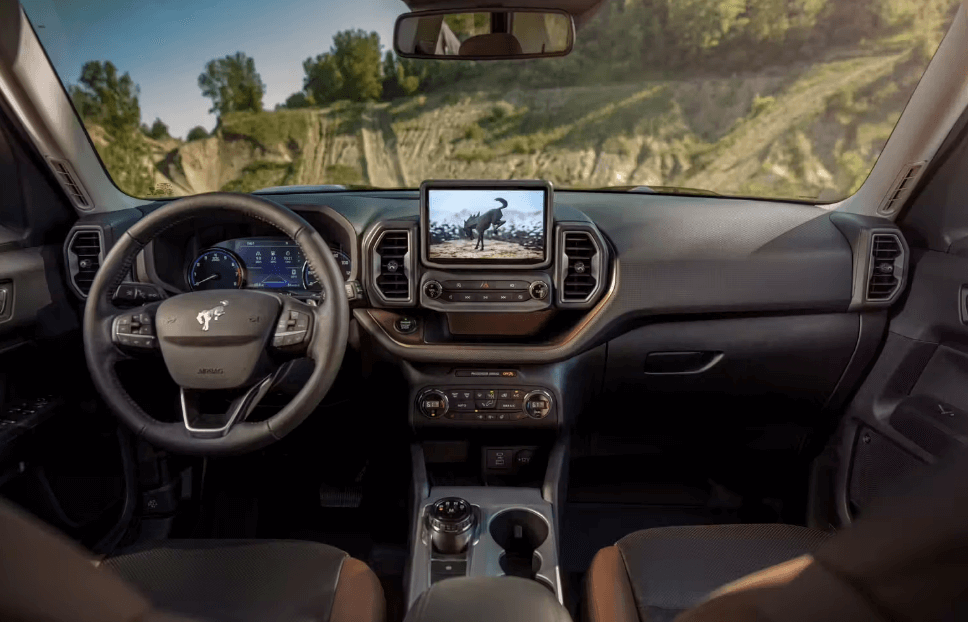
Off-road capability
Not close, and it is worth being precise about why rather than just asserting it.
The Bronco has a two-speed transfer case with low range, which multiplies torque for crawling. It offers front and rear locking differentials on the right trims, disconnecting front sway bars for articulation, and the Sasquatch package adds 35-inch tires from the factory. Ground clearance, approach angles, and departure angles are all built around trail use.
The Bronco Sport has all-wheel drive, not four-wheel drive, and no low range. The Badlands trim gets a genuinely clever twin-clutch rear drive unit that can send torque side to side and even mimic a locking differential, plus more ground clearance and better angles than the lower trims.
That makes the Bronco Sport Badlands considerably more capable than a typical crossover. It will handle forest roads, snow, mud, and moderate trails without complaint. It will not rock crawl, and it should not be asked to.
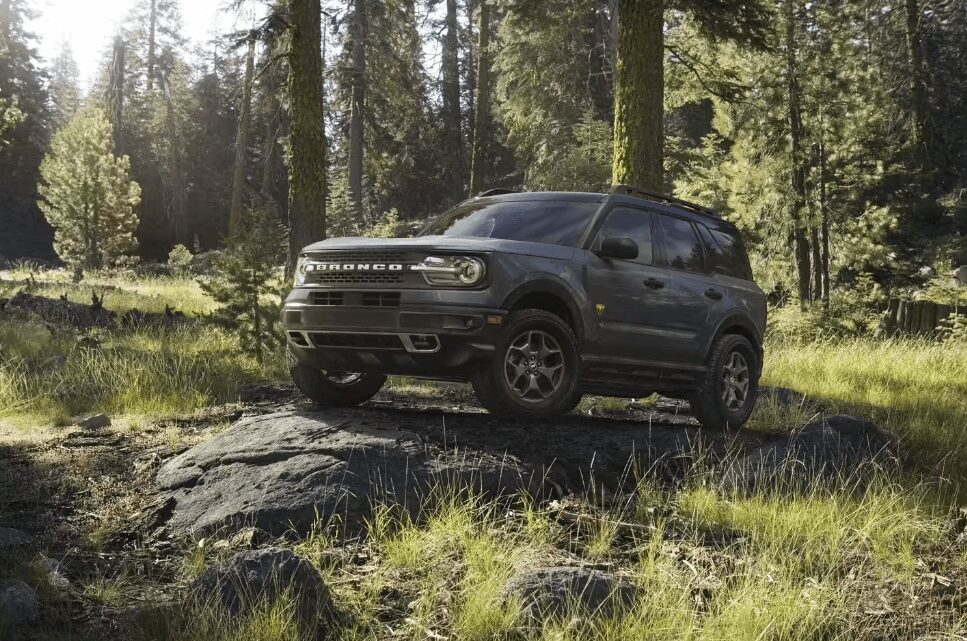
Size, cargo and towing
The Bronco Sport measures about 172.7 inches long, which puts it alongside compact crossovers like the Subaru Crosstrek. The two-door Bronco is similar at 173.7 inches, and the four-door stretches to 189.4, which is midsize SUV territory.
Cargo behind the rear seats runs roughly 32.5 cubic feet in the Bronco Sport, 38.3 in the four-door Bronco, and only 22.4 in the two-door Bronco. The two-door is the least practical of the three by a wide margin, which is the price of the shape.
Towing is 3,500 pounds for the Bronco against 2,200 for the Bronco Sport, and that gap is the frame doing the work.
On-road manners and fuel economy
Here the Bronco Sport wins, and it is not a small win.
A unibody crossover with a transverse engine rides better, is quieter at highway speed, parks more easily, and returns considerably better fuel economy. Roughly 26 mpg combined with the three-cylinder and 23 with the 2.0-liter, against 17 to 21 for the Bronco depending on engine and how many tires and accessories you have hung off it.
The Bronco is more composed on pavement than a Wrangler thanks to that independent front suspension, but a boxy body-on-frame vehicle on aggressive tires is never going to be quiet. With the Sasquatch package and 35s, road noise becomes a defining feature of ownership.
Price
The Bronco Sport has always undercut the Bronco, and the gap widens as you climb the trims. What matters more than the starting figures, which move constantly, is where each one lands loaded: a well-equipped Bronco Sport sits near a base Bronco, and a Bronco with the off-road hardware people actually want climbs a long way past that.
Check current pricing directly, because both models have been repriced and restructured multiple times, and the Bronco Sport was fully redesigned for 2025.
So which one should you buy?
Buy the Bronco if you want the doors off, you tow anything meaningful, or you off-road properly rather than aspirationally. Also buy it if you simply want the real thing, which is a legitimate reason as long as you have priced the fuel.
Buy the Bronco Sport if this is a daily driver that occasionally sees a dirt road, a trailhead, or a snowy commute. It is cheaper to buy, cheaper to run, easier to live with, and better at almost everything that happens on pavement.
The honest test: count how many times last year you were somewhere a crossover could not go. For most people the answer is zero, and the Bronco Sport Badlands covers the rest comfortably. Buying the Bronco for capability you will not use means paying for it every time you fill the tank.
Side by side
| Bronco | Bronco Sport | |
|---|---|---|
| Construction | Body-on-frame | Unibody |
| Drivetrain basis | Rear-wheel drive | Front-wheel drive |
| Low range | Yes | No |
| Locking differentials | Front and rear available | Twin-clutch rear unit on Badlands |
| Removable doors and roof | Yes | No |
| Engines | 2.3L turbo four, 2.7L twin-turbo V6 | 1.5L turbo three, 2.0L turbo four |
| Manual gearbox | Available on the four-cylinder | No |
| Towing | 3,500 lb | 2,200 lb |
| Combined mpg | Roughly 17 to 21 | Roughly 23 to 26 |
| Best for | Serious off-road, towing, open-air driving | Daily driving with light trail use |
If you are cross-shopping beyond Ford, our Jeep Wrangler review covers the Bronco’s direct rival, and our roundup of the best boxy SUVs covers the wider category. For Ford’s smaller trucks, see Maverick versus Ranger.
Common questions
Is the Bronco Sport just a rebadged Escape?
It shares a platform with the Escape but has its own body, suspension tuning, and all-wheel-drive hardware. The Badlands trim in particular is meaningfully more capable than any Escape.
Can you take the doors off a Bronco Sport?
No. Removable doors and roof panels are exclusive to the full-size Bronco.
Which is better in snow?
Both handle it well. The Bronco Sport is easier to drive on plowed roads and more efficient. The Bronco is better in deep unplowed snow thanks to ground clearance and low range.
Is the Bronco Sport Badlands actually capable off-road?
More than most crossovers, yes. The twin-clutch rear drive unit, extra clearance, and better angles handle trails, mud, and forest roads. It has no low range, so serious rock crawling is outside its range.
Which holds its value better?
The Bronco, particularly two-door and Sasquatch-equipped versions, which have stayed in demand since launch.