12 Reasons the Ford Mustang Dark Horse is the Ultimate Muscle Car
The Camaro is gone. The Challenger is gone. The Mustang Dark Horse is what's left, and it turns out that isn't a consolation prize. Five hundred naturally aspirated horsepower, a Tremec manual, and a name Ford hadn't used before. Here are twelve reasons it earns the badge, including one thing most write-ups get wrong.
Updated: August 18, 2026 // Top Lists
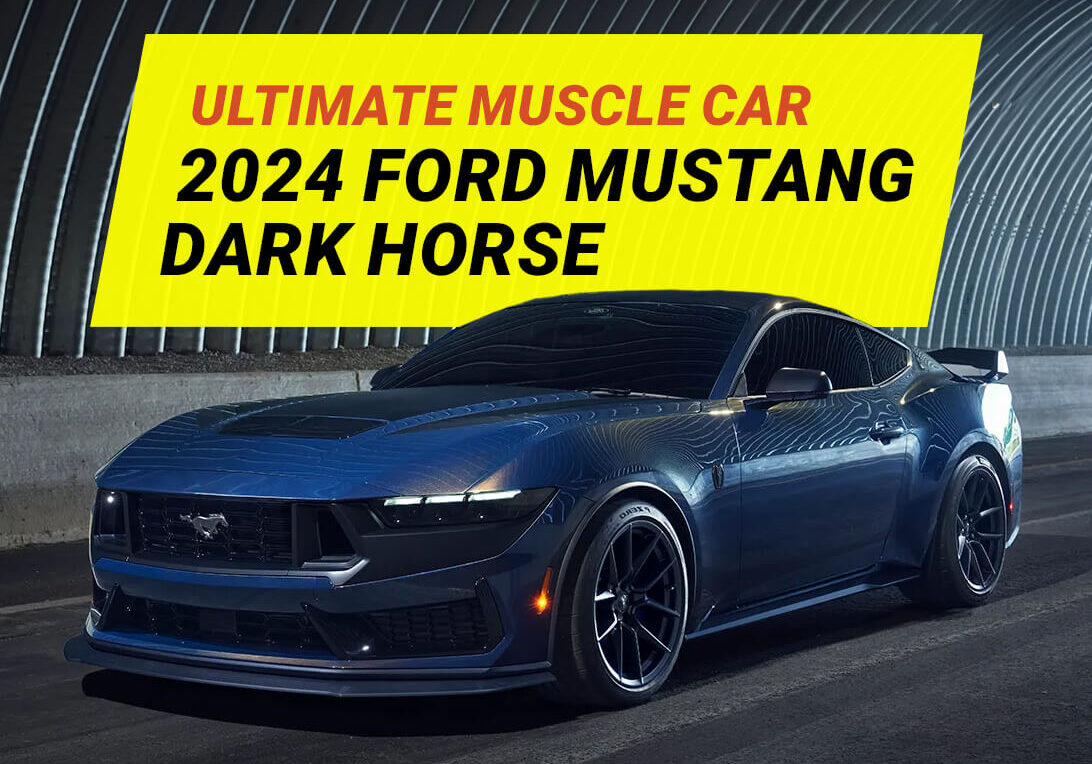
When Ford announced the Dark Horse in 2022, the pitch was that it slotted above the GT and below the Shelby models as a track-focused Mustang for people who actually drive on track. What nobody predicted was how quickly it would become the only game in town.
Dodge built the last Challenger in December 2023. Chevrolet ended Camaro production weeks later. The Mustang is now the last traditional American V8 pony car you can walk into a dealership and order, which changes the conversation about the Dark Horse considerably.
1. A 500-horsepower naturally aspirated V8
The headline number, and the way it is made matters as much as the figure. The Dark Horse runs a 5.0-liter Coyote V8 producing 500 horsepower and 418 lb-ft with no turbochargers and no supercharger, which makes it the most powerful naturally aspirated Coyote Ford has put in a road car.
Ford quotes a top speed of 168 mph and 0 to 60 in roughly four seconds. The engine gets forged connecting rods borrowed from the Shelby GT500 and a strengthened block, because 500 horsepower from natural aspiration means high revs and high cylinder pressures.
2. A real manual gearbox
A Tremec six-speed manual, standard, with rev matching you can switch off. In a segment where manuals have been quietly disappearing, Ford not only kept one but fitted a better one, and paired it with a proper mechanical shifter rather than a vague electronic afterthought.
A ten-speed automatic is available if you want it. Most Dark Horse buyers do not.
3. The electronic drift brake
A separate lever beside the shifter that acts as a hydraulic handbrake, developed with Vaughn Gittin Jr. It locks the rear wheels on demand, which is either a genuinely useful track and autocross tool or the single most entertaining thing on the option sheet depending on your intentions.
Nothing else in the class offers it from the factory.
4. Torsen limited-slip differential
Standard, and the unglamorous item that does the most work. A Torsen unit distributes torque between the rear wheels progressively rather than locking abruptly, which is what lets you get 500 horsepower down out of a corner without the car trying to swap ends.
5. Brembo brakes
Six-piston front calipers on 390mm rotors. Braking is where track-focused cars usually reveal themselves as trim packages rather than engineering exercises, and the Dark Horse holds up to repeated hard stops in a way a GT with the standard setup does not.
6. MagneRide adaptive suspension
Magnetorheological dampers that adjust in milliseconds, reading the road surface continuously and adapting. The practical result is that the car is compliant enough to drive daily and firm enough to work on a circuit, without you touching anything.
7. Pirelli Trofeo RS tires
Available with the Handling Package, these are close to a track tire with a road-legal tread pattern. Enormous grip when warm, and worth being honest about the tradeoff: they are noisy, they wear quickly, and they are not what you want in cold or wet conditions.
If the car is a daily driver, the standard tires are the smarter choice.
8. Aerodynamics that do actual work
The front splitter, the belly pan, and the rear spoiler generate real downforce rather than serving as decoration. Ford developed the package alongside the racing programs, and with the Handling Package the car produces meaningfully more downforce than a standard GT.
9. A cockpit built around the driver
Twin curved displays running under a single pane of glass, with configurable gauge layouts including a mode that mimics the analog dials from the Fox-body era. Anodized silver paddle shifters, dark chrome trim, and blue accent stitching are specific to the Dark Horse.
Ford took inspiration from fighter jet displays, which sounds like marketing until you sit in it and find that the important information is genuinely where you need it.
10. Colour and appearance packages
The Dark Horse launched with Blue Ember, a metallic that shifts noticeably between blue and near-black depending on light. An optional Appearance Package adds hood graphics and low-gloss black accents.
Cosmetic, obviously. But the exterior treatment is one of the few areas where the Dark Horse is doing something the GT cannot be optioned into.
11. Track-only siblings: Dark Horse S and Dark Horse R
Worth clarifying, because these get described as trim levels you can order and they are not. The Dark Horse R is a purpose-built race car for a one-make Mustang Challenge series, and the Dark Horse S is a track-day car sold without street registration.
Neither is road legal. Both exist to prove the platform, and the road car benefits from what they learn, but you cannot drive one to work.
12. It is the last one
The reason the Dark Horse matters more now than it did at launch. With the Camaro and Challenger both out of production, this is the only new naturally aspirated V8 muscle coupe with a manual gearbox on sale in America.
That is not a small thing. Emissions rules, electrification, and the collapse of the coupe market all pointed one direction, and Ford went the other way. Whether the Dark Horse is remembered as a great Mustang or as the last of something is a question that will answer itself in about a decade.
What it costs, and what to know
The Dark Horse launched at just under $60,000 and has climbed since, with the Handling Package and Appearance Package pushing a well-specified car meaningfully higher. Check current pricing rather than any figure written at launch.
Two honest caveats before you order one.
Running costs are real. Trofeo RS tires are expensive and short-lived, insurance on a 500-horsepower coupe is priced accordingly, and fuel economy is what you would expect. Our overview of how car insurance works is worth reading before you commit, particularly if you are under thirty.
A GT with the Performance Pack is close. It costs noticeably less and gets you most of the way there for road use. The Dark Horse earns its premium on a track and in the details, not in traffic. Our used Mustang pros and cons guide covers where the value sits across the range.
For the wider context, our Mustang evolution history traces the line from 1964 to here, and the Mustang versus Camaro comparison covers the rivalry that has now, at least for the moment, been settled by default.
Common questions
How much horsepower does the Mustang Dark Horse have?
500 horsepower and 418 lb-ft from a naturally aspirated 5.0-liter Coyote V8, the most powerful naturally aspirated version of that engine Ford has fitted to a road car.
Does the Dark Horse come with a manual transmission?
Yes. A Tremec six-speed manual is standard, with a ten-speed automatic available.
Is the Dark Horse faster than a Mustang GT?
Yes, though the gap on a straight road is smaller than the price difference suggests. The real separation shows up in braking, cornering, and how the car holds up over repeated hard laps.
Can I buy a Dark Horse S or Dark Horse R?
Only as a track vehicle. Neither is street legal, and the R is built for a specific racing series.
Is the Mustang the only muscle car left?
Among traditional V8 pony cars, effectively yes. The Camaro and Challenger both ended production, and the Charger returned as an electric and inline-six model rather than a V8 coupe.