What is Vehicle Upfitting?
Short Answer: Upfitting is converting a standard vehicle into a working one: shelving, racks, cranes, lighting, power. Done well it makes a crew faster and safer. Done badly it eats your payload, voids a warranty, and leaves you with a van that is technically overweight every day of its life. Here is what actually matters before you sign an order.
Updated: August 31, 2026 // Questions
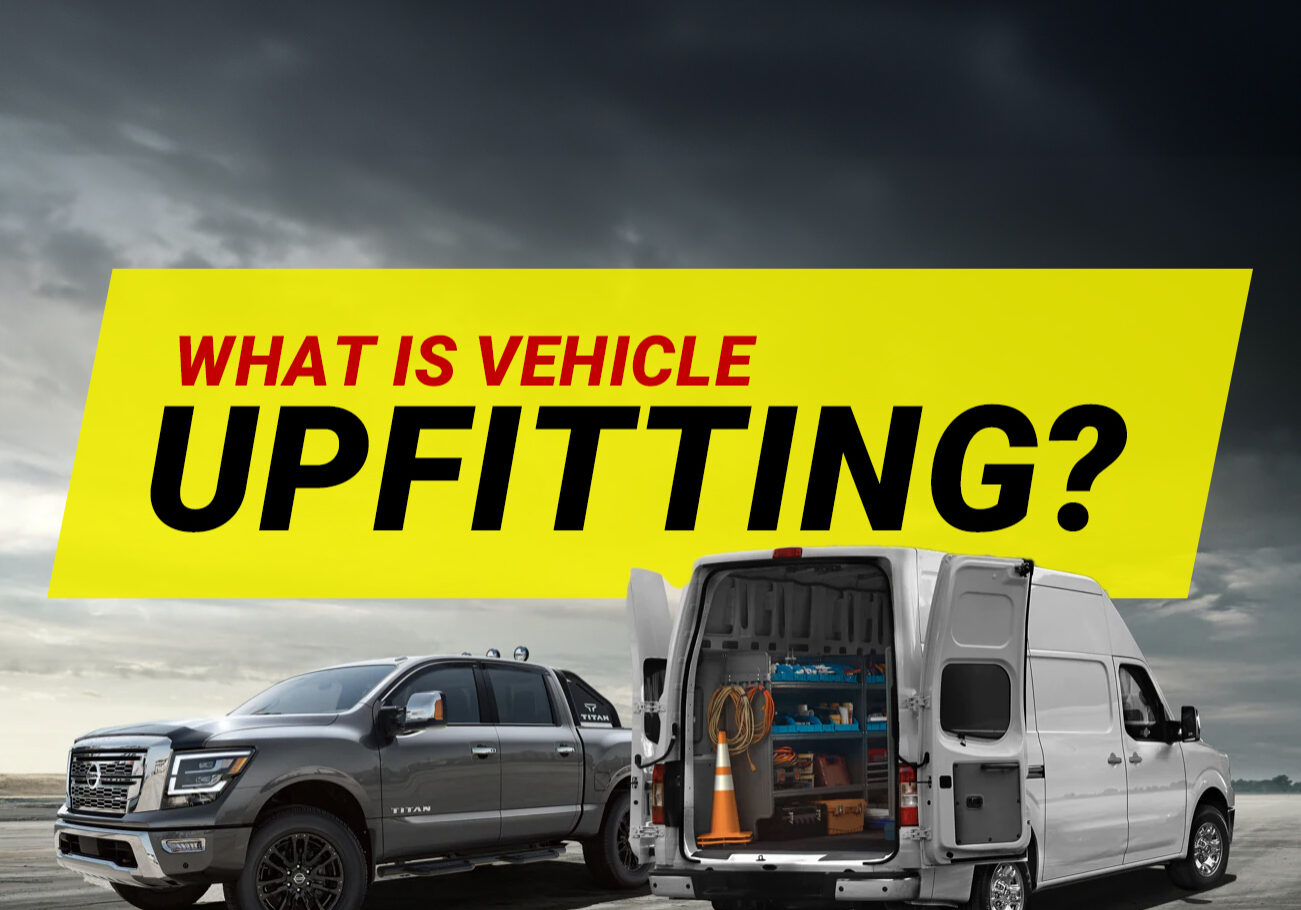
Vehicle upfitting is the process of adding equipment to a standard chassis, van or truck so it can do a specific job. A plumber’s van, an electrician’s service body, a utility truck with a crane, an ambulance, a police interceptor: all upfitted vehicles.
Manufacturers build a general-purpose vehicle. An upfitter turns it into a tool. The gap between those two things is where most of the cost, and most of the mistakes, live.
What gets fitted
The categories are consistent regardless of trade:
- Storage: shelving, drawer units, cabinets, partitions, and load-securing systems
- Exterior carriers: ladder racks, pipe tubes, roof racks, and hooks
- Bodies: service bodies, flatbeds, box bodies, and dump inserts that replace the factory bed entirely
- Lifting equipment: cranes, liftgates, and winches
- Power and lighting: auxiliary batteries, inverters, work lights, and beacons
- Safety: bulkheads and cab protection, backup cameras, steps and grab handles
- Climate control: refrigeration units and insulation for temperature-sensitive loads
The number that governs everything: payload
This is the part most introductory articles skip, and it is the one that causes real problems.
Every vehicle has a Gross Vehicle Weight Rating, the maximum it is legally and structurally allowed to weigh fully loaded. Payload is the GVWR minus the vehicle’s own weight, and it has to cover everything you add: the upfit, the tools, the materials, the fuel, and the people.
An upfit consumes payload before you load a single thing into it. A full steel shelving package can run several hundred pounds. A service body, a crane and a liftgate together can consume most of a one-ton truck’s capacity. If a page tells you upfitting makes a vehicle lighter and more fuel efficient, be sceptical, because the opposite is usually true.
Where fuel savings do appear, they come from right-sizing rather than from the upfit itself. If a properly organised smaller van can do the work of a larger one, you save fuel by dropping a class, not by adding equipment.
Two practical rules follow:
Calculate remaining payload before ordering. Vehicle curb weight plus upfit weight plus crew plus cargo, against GVWR. Do this on paper first.
Watch axle loading, not just the total. A crane or a liftgate hung off the rear can overload the rear axle while the vehicle is under its overall GVWR. Front and rear axle weight ratings are separate limits and both apply.
Compliance and who certifies the finished vehicle
When a manufacturer sells a chassis for upfitting, it often ships as an incomplete vehicle with documentation stating what the buyer must do to finish it legally. Whoever completes it takes on responsibility for certifying that the finished product meets federal motor vehicle safety standards.
For a small shelving job this is rarely an issue. For a body swap, a crane installation, or anything that alters structure, lighting or braking, it matters a great deal, and it is a reason to use an established upfitter rather than the cheapest quote.
Manufacturers run qualification programmes for exactly this reason, certifying upfitters who meet their engineering standards. Using one protects your warranty position and gives you somebody accountable if something is wrong.
Warranty, and how people get caught
An upfit does not automatically void a vehicle warranty, but it changes who is responsible for what.
The manufacturer covers the vehicle. The upfitter covers the equipment they installed. Where it gets difficult is a failure that could plausibly be caused by either, such as an electrical fault after an auxiliary power system was wired in, or a suspension problem on a vehicle that has been running at the top of its weight rating.
Use factory-provided upfitter switches and wiring provisions where they exist. Splicing into vehicle harnesses is the single fastest way to turn a warranty claim into an argument.
Ordering routes
Ship-thru. The vehicle goes from the factory to an approved upfitter before it reaches you, arriving finished. Cleanest option, usually best for warranty and compliance, and it requires planning far enough ahead to specify it at order time.
Aftermarket. You take delivery and then send the vehicle out to be upfitted. More flexible and often faster to arrange, but you are paying for a vehicle that sits unused while the work is done.
Either way, lead times on commercial upfits are long. Build that into your planning rather than assuming a vehicle ordered this quarter is working next quarter.
Does upfitting add resale value?
Not usually, and it is worth being straight about this because it is often claimed.
A heavily specialised upfit narrows the pool of future buyers. A van fitted out precisely for one trade is worth less to a buyer in a different trade than a plain van would be, because they have to pay to strip it out.
What holds value is modularity. Bolt-in shelving that can be removed, standard-format service bodies, and equipment that transfers to the next chassis all protect residual value. Welded-in, one-off installations do not.
The real return on an upfit is operational: fewer trips, faster jobs, less time hunting for tools, fewer injuries from lifting and climbing. Those are genuine and measurable. Resale is not where the case is made.
Planning an upfit properly
Start with the work, not the catalogue. Follow a crew for a day. What do they carry, what do they reach for most, what do they have to unload to get at something else? That produces a better layout than any standard package.
Involve the drivers. They know where the wasted motion is, and equipment chosen without them tends to get worked around rather than used.
Prioritise access and safety. Drop-down racks, additional steps and proper grab handles reduce the injuries that actually happen in this work, which are falls and lifting strains rather than crashes.
Standardise across the fleet. Identical layouts mean any driver can work out of any vehicle, and spares and training simplify.
Cost it over the life of the vehicle. Purchase, upfit, fuel at the resulting weight, maintenance, insurance and disposal. Our overview of financing options for commercial vehicles covers the purchase side, and how insurance is calculated is worth reading, since modified commercial vehicles are rated differently and equipment needs declaring.
A note on lighter-duty options
Not every job needs a full-size van. Compact pickups have taken a share of light commercial work, and for a trade that carries modest tools rather than bulk materials they can be enough. Our Ford Maverick review and the Maverick versus Ranger comparison cover where that line falls, and our Ranger review covers the mid-size option.
For an example of upfitting taken in the other direction, as a retail product rather than a work tool, see our piece on Black Widow trucks, which are dealer-sold trucks modified by a specialist before sale.
Common questions
Can any vehicle be upfitted?
Most can be adapted in some way, but payload, roof structure and manufacturer restrictions all set limits. A heavy upfit on a vehicle with modest capacity leaves nothing to carry, which defeats the purpose.
Does upfitting void the manufacturer warranty?
Not by itself. The vehicle warranty stays with the manufacturer and the equipment warranty with the upfitter. Problems arise with failures that could be attributed to either, which is why using a manufacturer-qualified upfitter is worth the premium.
How much does upfitting cost?
From a few hundred dollars for basic shelving to well beyond the price of the vehicle for a crane-equipped service truck or a specialist conversion. Get quotes based on a specification rather than a general description.
Will an upfit hurt fuel economy?
Usually yes, because it adds weight and often aerodynamic drag. Roof racks in particular cost real economy at highway speed. The savings come from doing the job in fewer trips, not from the equipment.
How long does an upfit take?
Lead times for commercial upfits are commonly measured in months once vehicle availability and upfitter scheduling are combined. Plan well ahead of when you need the vehicle working.
Should I upfit new or used vehicles?
New if the equipment will outlast the chassis and you want warranty alignment. Used can make sense for modular equipment you intend to transfer, since you avoid paying for depreciation on the vehicle underneath it.