
Is a Corvette a Muscle Car?
Short Answer: No. It's a sports car, and the current mid-engine cars are stretching toward supercar territory.
Updated: August 12, 2026 // Questions
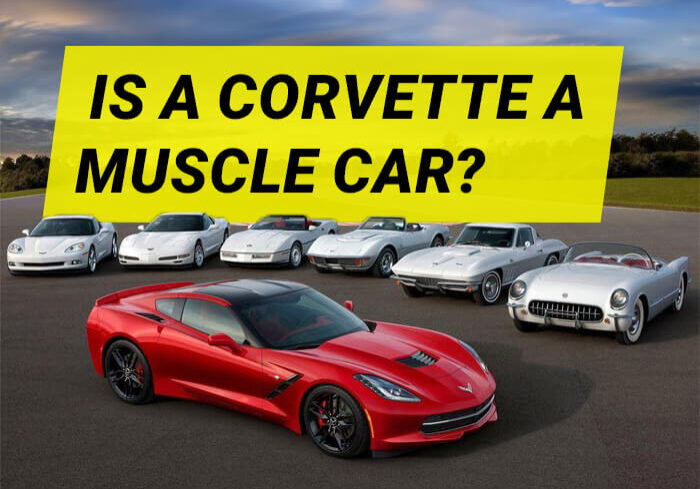
That answer annoys people, partly because the Corvette hits so many of the surface markers. American. V8. Loud. Fast in a straight line. Beloved by exactly the crowd that loves muscle cars. Merriam-Webster’s definition of a muscle car is any of a group of American two-door sports coupes with powerful engines built for high-performance driving, and by that wording the Corvette walks right in.
The dictionary is just being loose. The term has a much more specific meaning to the people who use it, and the Corvette has never fit it.
What a muscle car actually is
The formula was set in 1964, when Pontiac dropped a 389 into the mid-size Tempest and called it the GTO. That is the whole idea: take an ordinary, affordable, mass-market family car and install the biggest engine that will physically fit.
Four things fall out of that:
It starts as something boring. The Chevelle, the Fairlane, the Coronet, the Satellite. Grocery-getters with a bigger motor bolted in.
It was cheap. Muscle cars were aimed at young buyers with limited money. Speed per dollar was the entire pitch.
It was built for a straight line. Brakes and suspension mostly went along for the ride. Drum brakes and leaf springs under 400 horsepower was not unusual.
It has a back seat. Two doors, but four seats, because the family sedan underneath came with four.
Now check the Corvette against that list. It was never based on anything. It has never had a back seat. It has never been the cheap option in Chevrolet’s lineup. And it was engineered from the first drawing to go around corners.
Zero for four. The Corvette isn’t a muscle car that happens to handle well. It’s a different kind of car that shares a country of origin and an engine layout.
The Corvette has always been a sports car
Chevrolet said so from the start. The 1953 car debuted at the GM Motorama as an American answer to the small European roadsters coming back from Europe with returning servicemen. Two seats, fiberglass body, low and light.
The early ones were not fast. The first Corvettes came with a six-cylinder engine and a two-speed automatic, which is not a muscle car spec sheet in any universe. Chevrolet was chasing the idea of a sports car before it had the drivetrain to deliver one.
The V8 arrived in 1955 and the car got serious. The 1963 Sting Ray added independent rear suspension, which is the detail that really settles the argument. Independent rear suspension in 1963 was a handling decision, and an expensive one. Muscle cars were still riding on live axles and leaf springs a decade later because nobody buying them cared. Chevrolet cared, because it was building a different thing.
Everything since has followed that line. Lightweight bodies, low-slung packaging, and in 2020 the move to a mid-engine layout, which is the single least muscle-car decision an American manufacturer can make. Putting the engine behind the driver is what you do when cornering balance and traction out of a corner matter more than anything else.
Where the confusion comes from
Two things, mostly.
The first is that the Corvette and the muscle cars shared showrooms, an era, and an audience. If you grew up in 1969 loving American V8s, the Corvette was part of the same world as the Chevelle SS. Culturally they’re cousins. Categorically they’re not.
The second is that big-block Corvettes existed. The L88 and ZL1 cars of the late sixties were brutal, and if you only look at the engine bay they read as muscle. But you can put a big engine in a sports car without turning it into a muscle car, the same way you can put a small one in a Chevelle without turning it into a sports car. The platform underneath is what determines the category.
The comparison, cleanly
| Muscle car | Corvette | |
| Starting point | An existing mass-market sedan or coupe | Purpose-built, its own platform |
| Seats | Four, two doors | Two |
| Positioning | The affordable fast option | The expensive halo car |
| Engineered for | Straight-line acceleration | Cornering, braking, and balance |
| Layout | Front engine, rear drive, live axle for most of the classic era | Front engine with independent rear from 1963, mid-engine from 2020 |
| Examples | GTO, Chevelle SS, Road Runner, 442 | There is only the one |
So what is the C8, then?
Sports car is still the honest answer for the base car. It’s fast, but so is a Cayman, and nobody calls a Cayman a supercar.
The upper trims are a different conversation. Once you get to the flat-plane-crank Z06 and the twin-turbo ZR1, you’re looking at cars that trade lap times with things costing three times as much, and the supercar label stops being a stretch. Chevrolet has more or less admitted this by pricing them where it does.
That’s still not muscle. Nothing about a flat-plane crank V8 screaming past 8,000 rpm has anything to do with a 389 in a Tempest.
The short version
The Corvette isn’t a muscle car and never was. Muscle cars are ordinary cars with extraordinary engines, sold cheap. The Corvette is an extraordinary car sold as one, engineered around cornering from the day it appeared in 1953.
If you want a Chevrolet muscle car, the answer is a Chevelle SS, or a Camaro if you’ll accept a pony car. The Corvette is doing something else entirely, and has been for seventy years.
Common questions
Is a Corvette a sports car or a supercar? Sports car through and through. The current top trims blur into supercar performance, but the base car is a sports car by any normal use of the word.
Is a Camaro a muscle car? Technically it’s a pony car, a smaller and cheaper category the Mustang invented in 1964. In casual conversation people file pony cars under muscle, and nobody will fight you over it.
Why isn’t a big-block Corvette a muscle car? Because the category is defined by the car you start with, not the engine you finish with. The Corvette was never an economy platform with a big motor added.
Does the Corvette’s engine make it a muscle car? No. A pushrod V8 is a common ingredient, not the definition. Plenty of muscle cars left the factory with modest engines and plenty of sports cars have V8s.
What was the first muscle car? Most people point at the 1964 Pontiac GTO. Some argue for the 1949 Oldsmobile Rocket 88, which used the same recipe fifteen years earlier. Both cases are reasonable.
Source: Muscle car definition, Merriam-Webster. https://www.merriam-webster.com/dictionary/muscle+car






Sources:
- Definition of MUSCLE CAR. (2023, July 19). Muscle Car Definition & Meaning - Merriam-Webster. https://www.merriam-webster.com/dictionary/muscle+car